
The Climb
Taking a look at ranked game modes

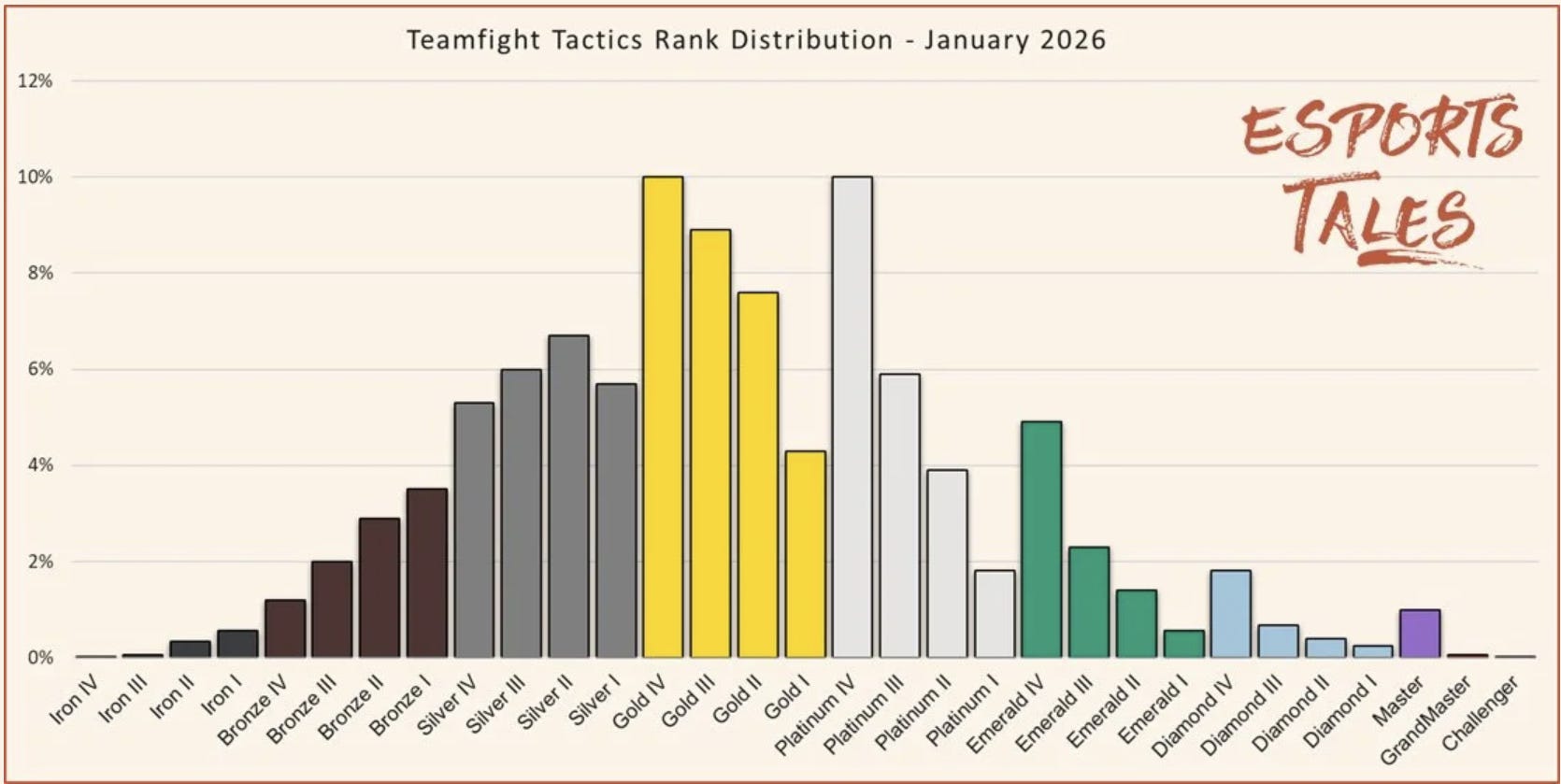
I recently hit Platinum rank for the first time in Teamfight Tactics since I first picked up the game last summer. While this isn’t very impressive by any means (Platinum IV is roughly the 73rd percentile), it’s a personal best for me, and it’s caused me to reflect a bit more on ranked game modes in general. Below is the current distribution for Set 16, if you're curious. 1
In my gaming career, there are a small handful of games where I decided to engage with ranked mode. If I were to play ranked matches in every single multiplayer game I’ve ever played, I’d probably end up with a few broken keyboards and fail out of business school. For me, I’ve played ranked in World of Warcraft (rated arenas and battlegrounds, although Mythic+ could also be considered a form of rated play), Apex Legends, Marvel Snap, and Teamfight Tactics. Each of these games approaches its ranked systems in a unique way, but in my opinion, there are some truisms that hold up across ranked modes in general. I’ll be discussing them through the framework of players, “makers” (meaning developers), and “money” (the larger business side of things).
Players
Players usually choose to engage with ranked modes to either test out their skill through climbing the ladder or compete with others at (or slightly below/above) their level. Throughout my gaming journey, I’ve heard the term “pub stomping” thrown around many times, referring to the process of highly skilled players joining unranked lobbies just to play with their food, so to speak. While a lot of players opt in to ranked lobbies to see how high they can push their rank, it’s important to consider the players who are just there to play some “fair” matches. For example, a Silver-ranked TFT player may not be actively trying to get all the way to Emerald. They might just be content with their placement and the difficulty of their matches.
In general, as you can see above, ranking distributions follow a rough bell curve. The priorities of each player at different points along the curve may vary. For example, a player ranked Grandmaster or Challenger probably knows they’re in the top echelon of the game and will expect longer match queue times. To them, playing as many games as possible isn’t the priority. They’re more focused on finding an evenly matched game. On the other hand, a less serious player at the lower end of the curve is probably going to get frustrated if they have to wait 10 minutes or more for a game.
As players climb, they also naturally expect the stakes to become higher. To pull an example from Apex, each increase in rank leads to the player starting at a larger points deficit that they have to overcome by the end of their match. When I was playing this type of ranked match, I found myself using more conservative strategies to protect my ranking as much as possible. In earlier ranks, I could run and gun without much fear of a big setback from a loss. I used similar strategies in Marvel Snap, gambling fewer cubes on average the higher I climbed in order to minimize losses, even if that made the climb feel slow and painful sometimes.
While players’ motivations, priorities, and playstyles may vary depending on their rank, I imagine the ranked player base as a whole is more homogenous compared to the game’s full player base.
Makers
The cool part about ranked modes is that players are self-selecting into a more intense experience. This self-segmentation allows developers to focus on things they know should be a priority. Like I mentioned earlier, extremely high-ranked players probably don’t care much about wait times, which gives developers more flexibility on the backend to optimize for match quality. Part of my inspiration for writing this piece comes from a white paper I read the other day from Activision’s research team, where they explain how their ranked matchmaking works. In an FPS game, ping and delta ping become increasingly important, while a game like TFT or Marvel Snap may be more forgiving. Check out the paper here if you want to read more about Call of Duty specifically.
There’s also an ongoing debate over whether or not a game developer should be highly ranked in the game they work on. TFT’s Senior Director of Game Design, Stephen “Mort” Mortimer, wrote an article a while ago that touches on this topic, and I think he explains it well. I’ll link the piece in the footnotes.2 Mort ends the article by asking the TFT (and broader gaming) community: would you rather your game developers focus on grinding to the highest rank possible and risk burning out, or focus on building the best and most fun game they can? It took Mort 300 hours over an eight-week period to reach Challenger. I’ll let you decide what you think of that, but for now, I’m inclined to agree with him.
There are a lot of design considerations when creating ranked modes. How many ranks should there be? What’s the reward for a win at each rank and the penalty for a loss? How long should a ranked season last? Should players from very different ranks be allowed to queue together? How often should balancing patches be released to shift the meta? Even though I have some personal opinions, I don’t know exactly how these questions are answered, and I’m sure there’s a lot of data and discussion that goes into it.
Money
From a business perspective, ranked modes serve as a sticky feature that increases player engagement. Each new ranked season typically resets players back to square one (or to a lower tier if the game uses a split system). Players can either try to match their previous best or push for a new high. Leaderboards have been around in video games for ages, but these days, people chase the next shiny emblem next to their name instead of trying to get their initials at the top of the screen. Just like with player priorities, playtime behavior in ranked can also be more predictable. If studios know how many players engage with ranked, they can plan and forecast more effectively.
This predictability could make it easier to estimate revenue and player purchases. For live service games that primarily monetize through battle passes and cosmetics, I wouldn’t be surprised if there’s a correlation between ranked player volume and in-game purchases. More dedicated players are probably more willing to spend money. Of course, there are always casual whales who log in once in a while and spend a ton just because they can, but that’s not representative of most casual players. As I heard in a recent Deconstructor of Fun podcast episode, “nothing beats free,” and that’s probably how many casual players approach monetization. On the other hand, if hardcore ranked players care more about match quality and skill progression, they may not be interested in spending money on cosmetics at all.
For games that don’t currently have a ranked mode but are considering one, there’s also the cost factor to think about. As the Call of Duty white paper outlines, building a ranked system from scratch is no small task. The engineering time and technical hurdles might not be worth it financially, even if it means gaining a more dedicated slice of players.
Final Thoughts
Ranked modes can be a lot of fun, but they can also be really frustrating. Many players are better off just enjoying the game casually and playing at their own pace, and that’s totally fine. Some games don’t lend themselves well to ranked play anyway. Arc Raiders comes to mind—would you rank based on ARCs destroyed, players killed, or loot value?
For me, ranked play is something I engage with in seasons. Some months I catch the bug and want to test my skill and push my limits. Other times, I’m just looking to unwind and have some fun after a long day at work.
Thanks for reading this edition of Riley’s Realm, and I hope to see you again soon!3
Graph and data courtesy of esportstales.
Really liked how you outlined the potential priorities of players on different ends of the skill spectrum - spoken like a true gamer!
Reading this also made me feel nostalgic of my memories climbing the prestige ranks in MW3!
Great writeup, Ri! I’m a firm believer that in-game purchases should NOT instantly allow players to fare better in ranked games. I’ve been on the other end of this in games like FIFA Ultimate Team and Clash Royale. It’s incredibly frustrating when you hit a wall, and the only way to progress further is to invest more real money.