
My First GDC!
Some thoughts and takeaways

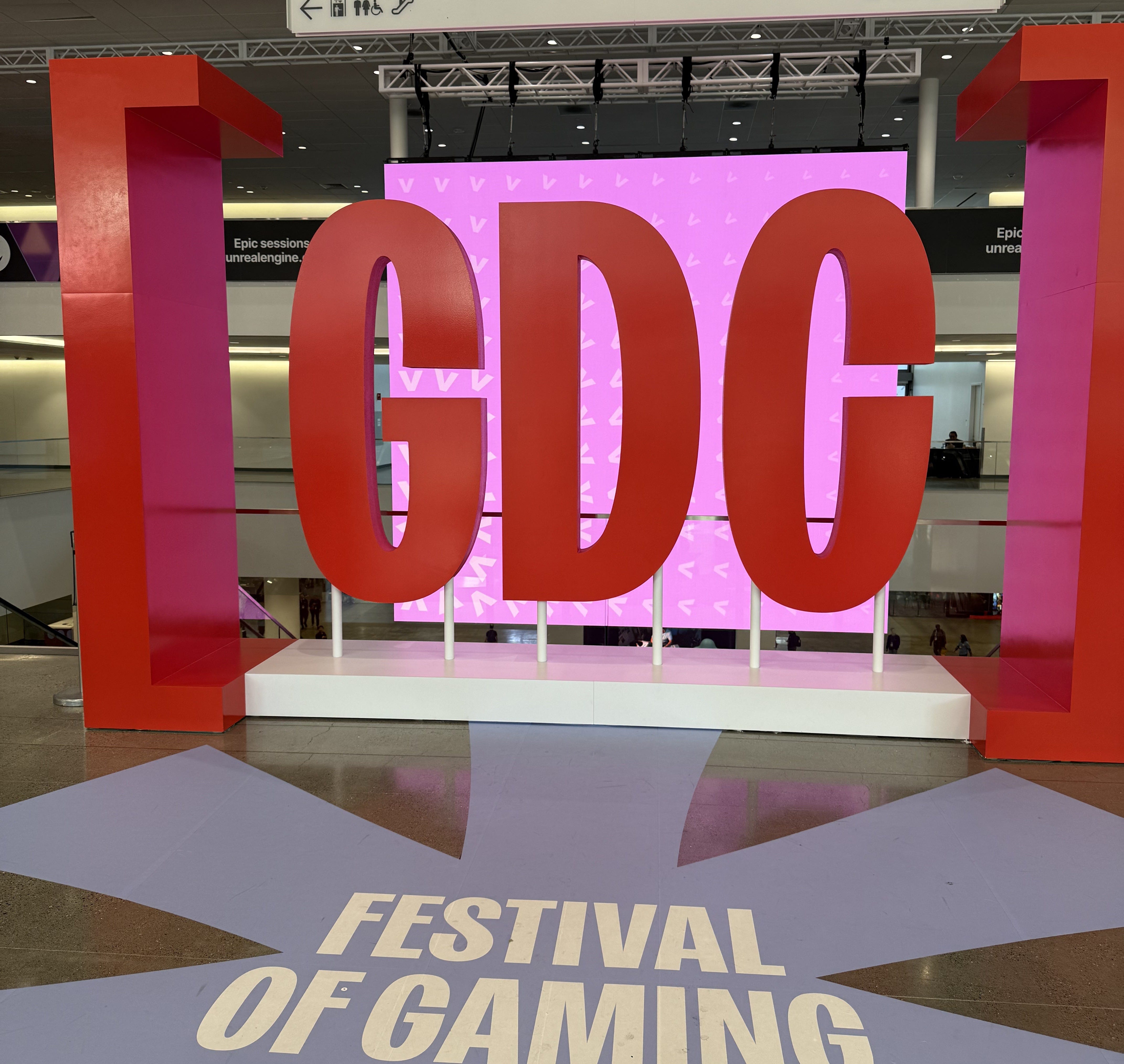
I recently had the pleasure of attending my first GDC, or “GDC Festival of Gaming” as it was recently renamed. Each March, game developers, enthusiasts, and students descend on San Francisco for one week to attend expert lectures, network, and chat about the future of the gaming industry. Sunday night, as I sat in my motel room in Chinatown, I was overwhelmed by the sheer volume of interesting talks and events on offer.
Did I want to focus on career-oriented talks? Talks digging into gameplay mechanics? Audio design? Player retention? After about 20 minutes of scrolling through the conference agenda, I realized I would not be able to do it all, and that was okay. It appeared to be organized like a music festival, where “headliners” were spread out across the same time slots to manage the crowd.
I decided on a mixed approach: attending lectures I thought would be useful for my career, stuff I was interested in just for fun, and taking time to network and meet other MBA students and gaming professionals. Here are some of my thoughts, takeaways, and interesting bits of information that stuck with me from the week.
First Impressions
Walking up to the Moscone Center South Hall on Monday morning, the atmosphere around the building was already buzzing. After grabbing my badge, I went straight over to the West Hall, where most of the action took place. The first lecture I attended was titled “‘Battlefield 6’: Game Feel is the Message” by Jac Carlsson, a Game Designer at EA Dice.
The room was packed wall to wall, so much so that I had to stand in the back just to attend. Jac discussed how his extensive background in creative dance helped him transition into the world of game design, helping the Battlefield team create gameplay that felt alive. “Game feel is the alignment of perception and gameplay.” Something as simple as the angle at which the user’s avatar leans while shooting can make or break the immersion of a military shooter like Battlefield.
After this first lecture, I knew I was in for a treat. In a minute, eight hours had gone by. On the walk back to my Chinatown digs, I felt energized and exhausted. This is what GDC feels like!
Favorite Talks
While I can honestly say I enjoyed every lecture I went to, I’ll cover my three favorites in this post, in no particular order.
‘Using Telemetry (the Right Way) is a Game-Changer for Game Tools’ from David Lightbown (Director of UX at Ubisoft Montreal)
As a former engineer, this one hit home. When making game tools, how does one figure out what to optimize, what’s missing, and what can be pruned away? David began his talk by mentioning that, ideally, the tool maker and the tool user should be in the same room together. He shared a photo of John Carmack and John Romero’s old id Software workspace for emphasis. However, he quickly followed this up by acknowledging this is not always realistic, and often isn’t the case.
To solve this, we can use telemetry as an effective way to guide tools engineers in the right direction. Telemetry in game tool development is the automated collection and analysis of usage and performance data from your tools (like editors or build pipelines) to understand how they’re being used and where they’re falling short. It is also crucial for checking assumptions and verifying perceptions.
My main takeaway from this talk was that telemetry is most useful for identifying who is taking certain actions within a tool. While we can’t ignore the developer’s actions themselves, it’s important to understand who is taking those actions. Identifying a tool’s most active users and watching them work over time gives us valuable qualitative findings that can be used to support or debunk quantitative telemetry data and make meaningful improvements. David pointed out that you can identify about 80% of the problems with a tool’s user experience by watching the five most active users.
‘Making Sure Your Game Finds an Audience’ from Chris Zimmerman (Founder of Sucker Punch)
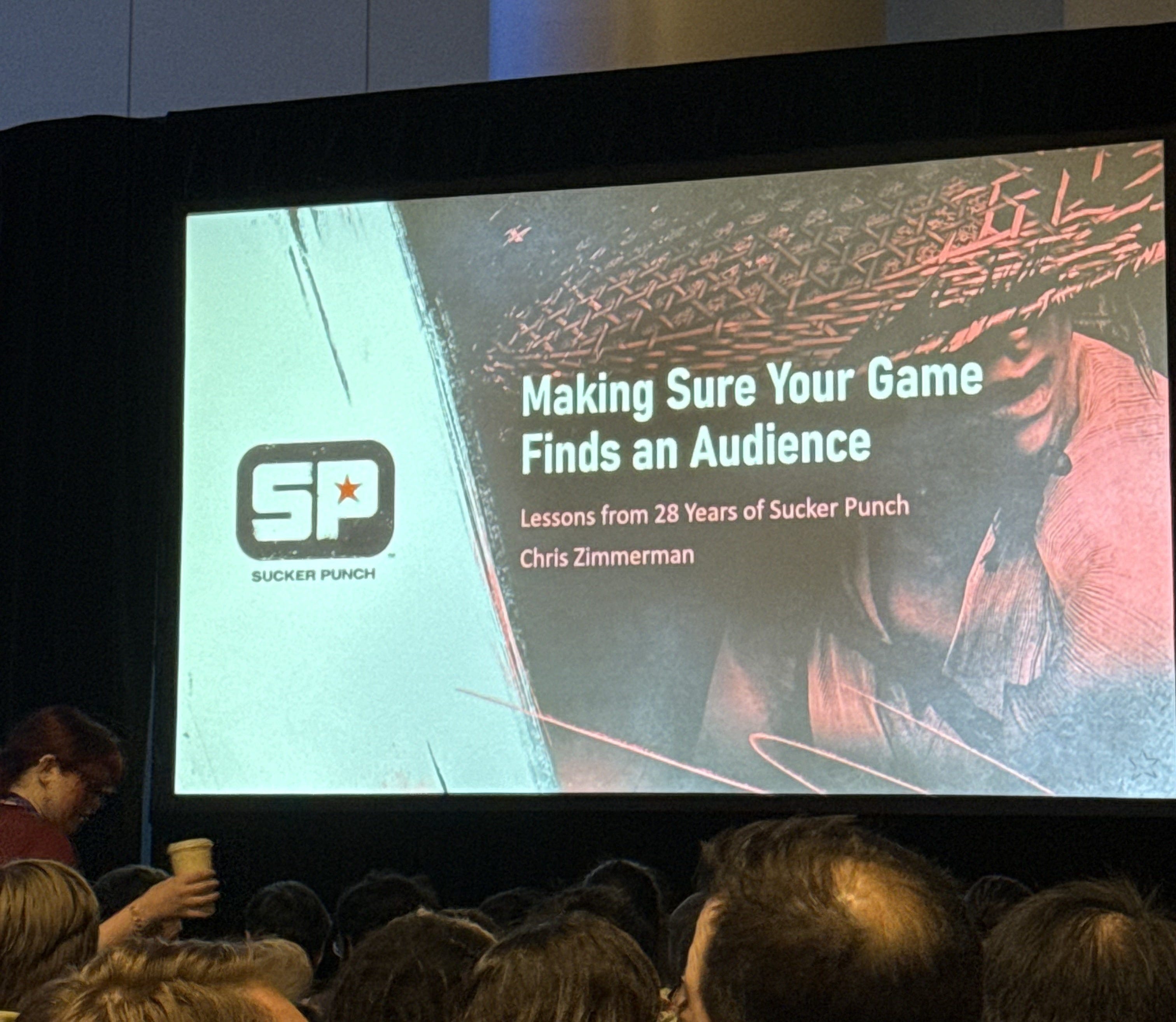
Chris drew on his 28 years of experience to share his recipe for making sure a game finds a thriving player base. While it seems simple on the surface, he spent almost an hour digging into this framework:
Find the spark
Avoid fatal mistakes
Prototype and iterate
Fix any mistakes through testing
The first step is finding the spark for your game. For Ghost of Tsushima, one of Sucker Punch’s most successful titles, the spark was: “Does this make me feel like a samurai?” At each stage of development, making sure that the game is aligned with the “spark” that is meant to make it special will help differentiate your game in an increasingly saturated market. Chris emphasized that the game will tell you what it wants to be, and you just have to listen to it. He also mentioned the importance of luck, believing that recognizing a stroke of luck when it happens is a skill that can make or break your game.
Once you’ve found that spark, it’s time to prototype and iterate. Our first ideas are probably not our best ideas, and Chris believes that consistent prototyping and testing is a better approach than fully speccing everything out. It’s hard to implement an entire game and then only test part of it. Consistency is easier than magic, so prototype until something feels magical once, and then make it happen like that every time.
Effective prototyping can also help dodge catastrophic mistakes that can kill your game in the cradle. Spending thousands of developer hours crafting a “perfect” final product only to fail to meet the expectations of your audience can easily snuff out momentum, so don’t try to ace it in one shot, but constantly revisit and enhance.
An effective testing strategy is also critical. Ghost of Yōtei had 18 different external tests during development, amounting to eight person-years of playing time, on top of the eight person-years of internal testing that was also conducted. While compromise in certain areas is necessary to make a great game, it’s clear that robust testing is not something to skimp on.
Making a successful game is clearly quite difficult, but using the recipe of finding the spark, prototyping, and testing as a north star can hopefully keep teams on track to deliver an amazing game that speaks for itself.
‘The Economics of a $1B Cosmetic Economy’ from Phil Black (Game Economist and DoF podcast member)
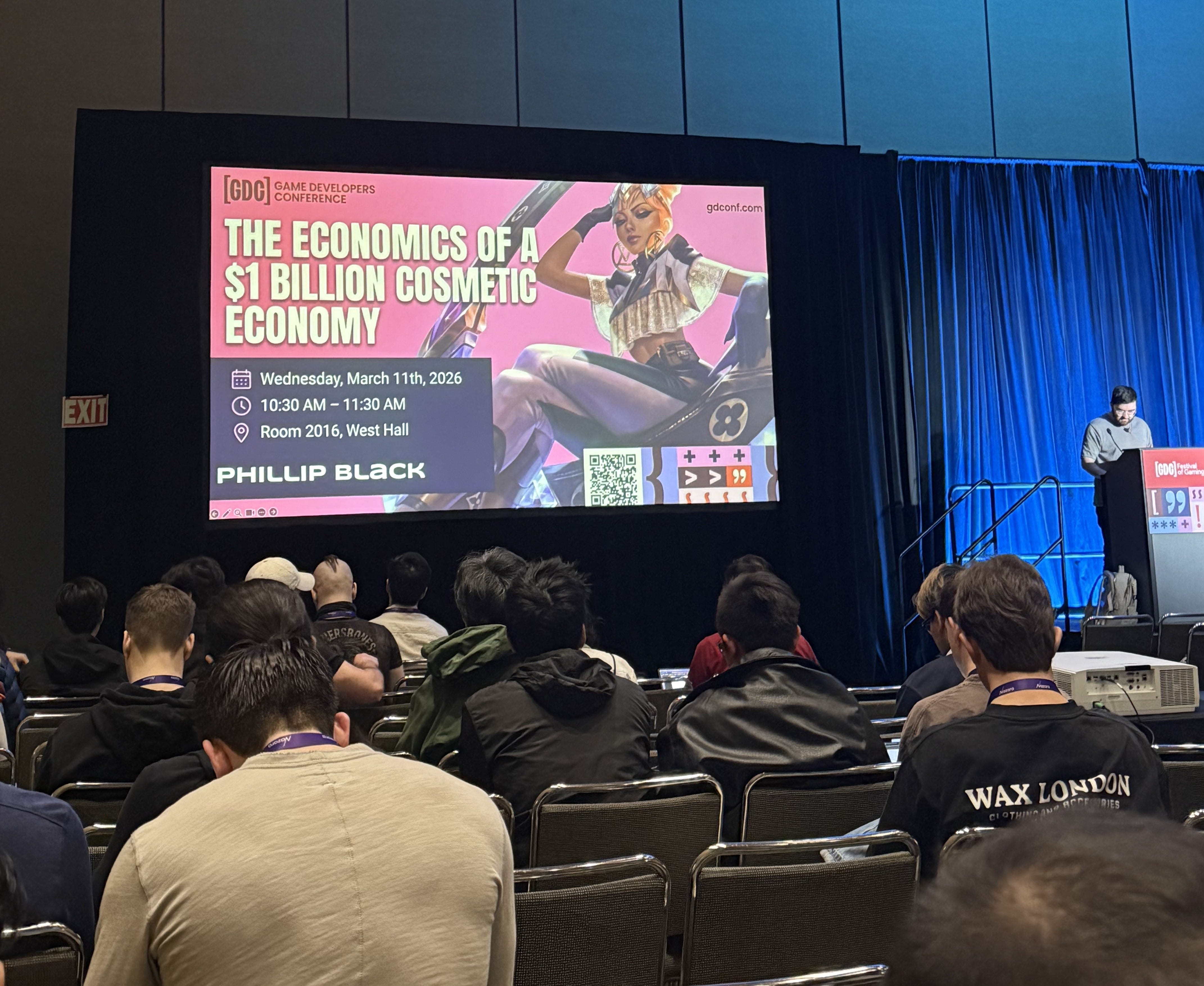
With F2P (free-to-play) games becoming more and more popular, monetization that works in-game is mandatory for a game to survive. Cosmetics such as weapon/character skins, nameplate decorations or emblems, and other non-gameplay-altering digital goods are the answer for many games. Phil mentioned what I thought was the perfect way to think about the hierarchy of cosmetic offerings for a game: could someone accurately order the rarity or price of a set of cosmetics without any labels? If yes, you’re on the right track.
Demand for different types of cosmetics is driven by “peacocking,” or showing off, fantasy fit, and prominence. However, there is also the phenomenon of cosmetic inflation that needs to be taken into account, which creates the need for the ceiling to keep being raised. Skins and costumes need to get more and more exotic, or product differentiation will fizzle out.
For fantasy fit, a player’s fantasy might center around a specific time, place, or theme. Making sure that there is alignment is critical for selling the fantasy. Phil used the example of a Call of Duty Nicki Minaj skin versus a Lionel Messi skin. The former sold really well, while the latter struggled. Nicki Minaj’s skin effectively reflected her real-life image using an outfit she might actually wear, while the Messi operator skin was in military garb and not one of his signature jerseys. This could explain the higher success of the Nicki cosmetic, as it preserved the fantasy more effectively.
Finally, Phil discussed prominence as a demand driver. He explained the concept he called the “mirror and stage” effect. Users can buy cosmetics either to look at themselves in a virtual mirror or to show off on a variety of virtual stages. A stage in this case might be a post-round winners’ podium, a killcam, dropping into a battle royale map as a group, or even main menus such as Fortnite lobbies.
(Bonus) Keynote speech from Rob Pardo, ex-Blizzard and founder of Bonfire Studios
Rob’s keynote speech centered around the “odyssey” his team has gone through while developing Bonfire’s debut game, Arkheron. In a hits-based industry, Rob posed the question: “How do you know when a game is going to be a hit?” His answer—when the team just can’t stop playing it. Be your own first and best customer. If the devs themselves don’t like a game, players certainly won’t. For games that succeed, Rob believes that at some point in the process, devs stop building the game they think players want and start building the game they truly believe in.
He stressed the importance of starting with the team, and the game idea comes later. As a studio founder, making sure that the whole team is aligned on the vision for the company is non-negotiable. Next, find the idea the team is best suited to create. This is referred to as a game “seed.” His team started with 35 different game seeds, eventually moving through a collaborative process that identified the most promising seeds and turned them into “saplings.”
After shrinking the pool to saplings, his whole team stack-ranked their favorites and were asked to defend each of their rankings. Specifically, he asked his team to “stack-rank the saplings based on which game you believe Bonfire has the best chance to make truly legendary.” By using lofty words like “legendary,” Rob sets the standards high, really driving home the idea of fitting the game to the team (not the other way around).
He also rejects the idea of an MVP, instead pushing for his team to find the “Minimum Lovable Game.” He encouraged his team to play the game to make the game and build from the inside out, eventually leading to the team both working on and playing their favorite game at the same time. However, it’s also necessary to iterate with your game’s community, as devs are both the best and worst playtesters of their own game. Players ultimately decide if you’re worthy of their time, so you have to be humble enough to let your game evolve with community feedback.
Final Thoughts
One of my biggest takeaways is that I seriously need to play Ghost of Yōtei sometime soon. Besides Chris Zimmerman’s talk, I also attended two other Sucker Punch lectures, and I was blown away by the depth of design and craftsmanship behind this game. From intelligent narrative design to the dynamic presentation of storylines and quests in the open world using an “Event Deck” system, I was truly impressed.
Attending so many talks reinforced the notion that there are many different approaches and philosophies to making games. Some prefer a faster approach that rests on constant iteration cycles, while others prefer longer cycles with more polish at each stage. Ultimately, there is no “right” or “wrong” way to make a game, but there are common threads that can be seen across successful titles that endure the tumultuous process of game development.
Listening to industry veterans who have been creating hits since before I was born was a humbling experience. There were so many useful nuggets of information and insights that I never would have thought of myself. While I cannot wait to dive into the gaming industry, I still have so, so, so much to learn. I am grateful that there are seasoned experts willing to share their trials and tribulations so that I can be an effective contributor one day soon. I will definitely be returning to GDC next year, and I can’t wait.
Thank you for reading this Riley’s Realm post! I hope you enjoyed it :)
Great stuff, Ri! Maybe one day you’ll be up there giving a talk of your own
Interesting read! I'd be curious to learn more about how game developers cater to different types of audiences (casual gamers vs. more serious gamers) during their development, and how those different demographics impact what areas and interactions of the game they focus on.